
Accessing a PET scan in Ontario 101

What are PET scans?
A positron emission tomography (PET) scan is a powerful imaging tool used to diagnose and map the progression of many life-threatening diseases such as prostate and colorectal cancer, lymphoma, leukemia, epilepsy, and heart disease.
While Ontarians may be more familiar with MRI or CT scans, PET and SPECT (single-photon emission computed tomography) scans are the preferred diagnostic tools for diagnosing and staging a number of serious health conditions.
Nuclear medicine scans, such as PET and SPECT, reveal changes in biochemical processes rather than physical changes in anatomy. In many cases, they can detect diseases earlier and more accurately than other tests such as MRI or CT - thus improving the chances of recovery.
In some cases, PET scans can even be used in place of more invasive procedures such as biopsies.

How do I get a PET scan in Ontario?
Ontario is continuing to invest in PET scan machines.
In recent years, Ontario has significantly streamlined the process for ordering a PET scan. Cancer Care Ontario (CCO) maintains a list of indications for which PET scans may easily be ordered - these indications are supported by rigorous evaluation that has demonstrated impact on patient management.
If a doctor wishes to order a PET scan for an indication that is not on the list, they may fill out a short application to the PET Access Program, which will be reviewed by a committee of doctors within a matter of days.

What are the challenges?
The challenges for patients accessing PET scans in Ontario have improved in recent years. Cancer Care Ontario has made progress in streamlining the system by which Ontario doctors can request a PET scan for their patients.
However, Ontario’s current approach still faces several challenges:
Outdated and underfunded PET infrastructure that lacks the capability to support cutting-edge diagnostics and treatment
Critical gaps in health human resources and regional access disparities
Increasing patient demand coupled with an insufficient supply of PET cameras
These and other ongoing, structural challenges are creating avoidable delays, scanner downtimes, and inequities in patient care. Most importantly, they risk preventing Ontario’s ability to provide patients with reliable access to emerging treatments despite its impressive commitment to global leadership in medical isotopes and harnessing innovation.
Modernizing PET access is about putting patients – not process - first in system decision-making and prioritization.
Demand for PET access is expected to increase, and Ontario must be ready. For example, the projected 40% increase (per year) in bone scans to accommodate PSMA imaging equals approximately an additional 2, 500* PET scans per month. There is also a projected 40% increase due to cardiac scans transitioning to PET scans, resulting in over 5,000* more scans per month. This alone represents an extra 7, 700 PET scans we know will be needed every month in Ontario - and the current system cannot meet this demand. It’s only the beginning of the gap between the capabilities and demand for PET and the access available to Ontario patients.
*per OMA collected data
Are PET scans used in other provinces?

PET-CT Exams per 1,000 Population for the latest year with data availability across public facilities, 2022 to 2023. As per the Canadian Medical Imaging Inventory 2022-2023
PET scans are used more frequently in almost every other province in Canada. While Ontario has made significant investments in PET scanners, the province has one of the lowest usage rates per capita in Canada.
Most recent data (2022-23) shows that in Ontario, 2 persons per thousand received a PET-CT scan, nearly half the national average of 3.9/1,000.
Ontario lagged behind every province except Manitoba, and was significantly behind Quebec, where 9 persons per thousand received a PET-CT scan.
When Canada is compared to other OECD countries, the difference is stark:
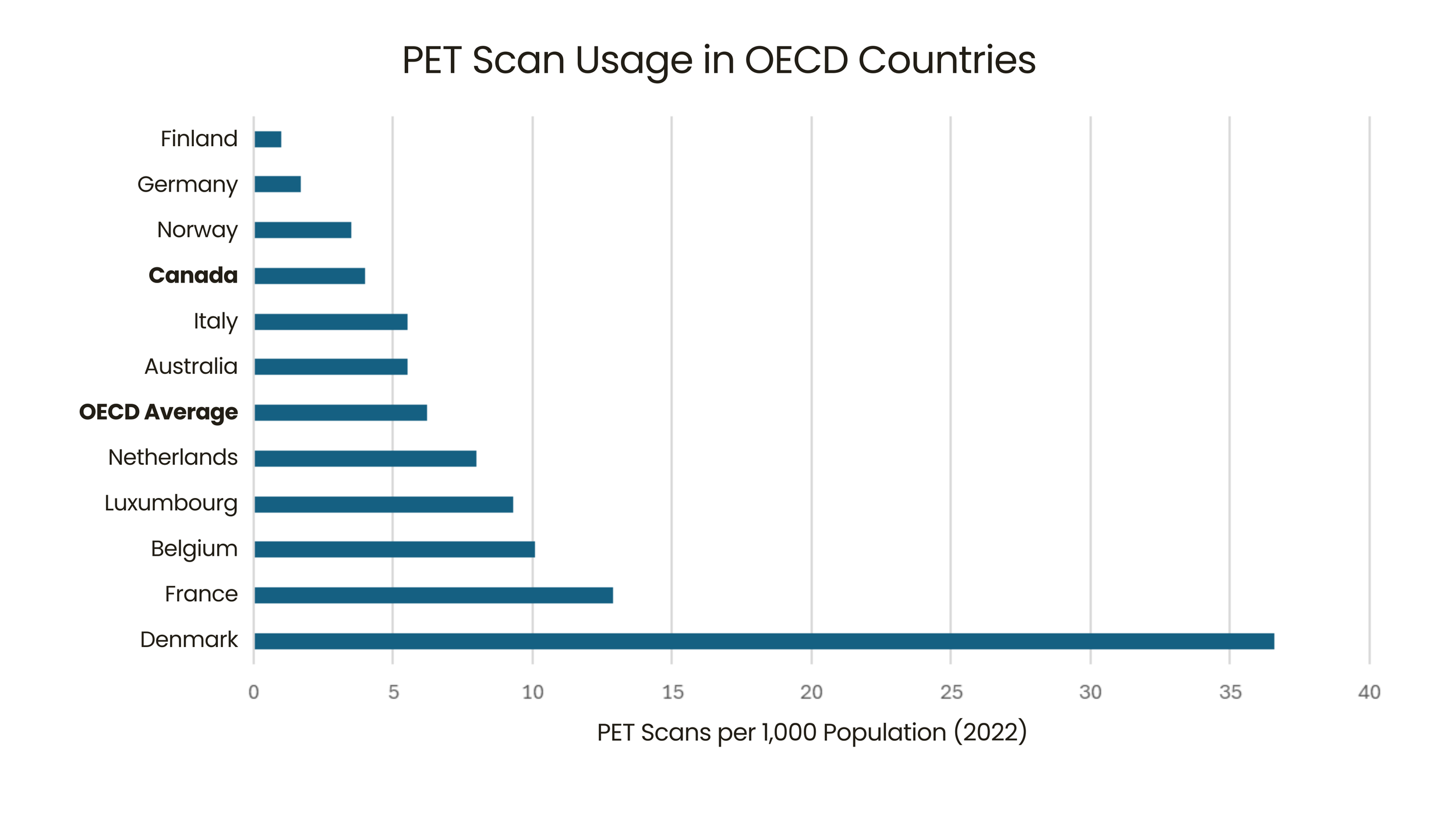
Data from OECD Data Explorer. See the Canadian Medical Imaging Inventory 2022-2023 for more information.
Ontario’s PET scanners could do more.
Ontario has a highly-skilled nuclear medicine community and enough PET scanners to significantly improve utilization rates. PET scans are powerful tools that have a demonstrated impact on patient management. Patients lives have been saved or extended by the information gleaned from a PET scan.
By re-directing patients to PET scans when appropriate, we also have an opportunity to reduce demand for our overburdened MRI and CT scanners and reduce wait times for these critical tests.
Modernizing PET access is about putting patients – not process - first in system decision-making and prioritization.